Fabric Manipulation Techniques in Textile and Fashion Design
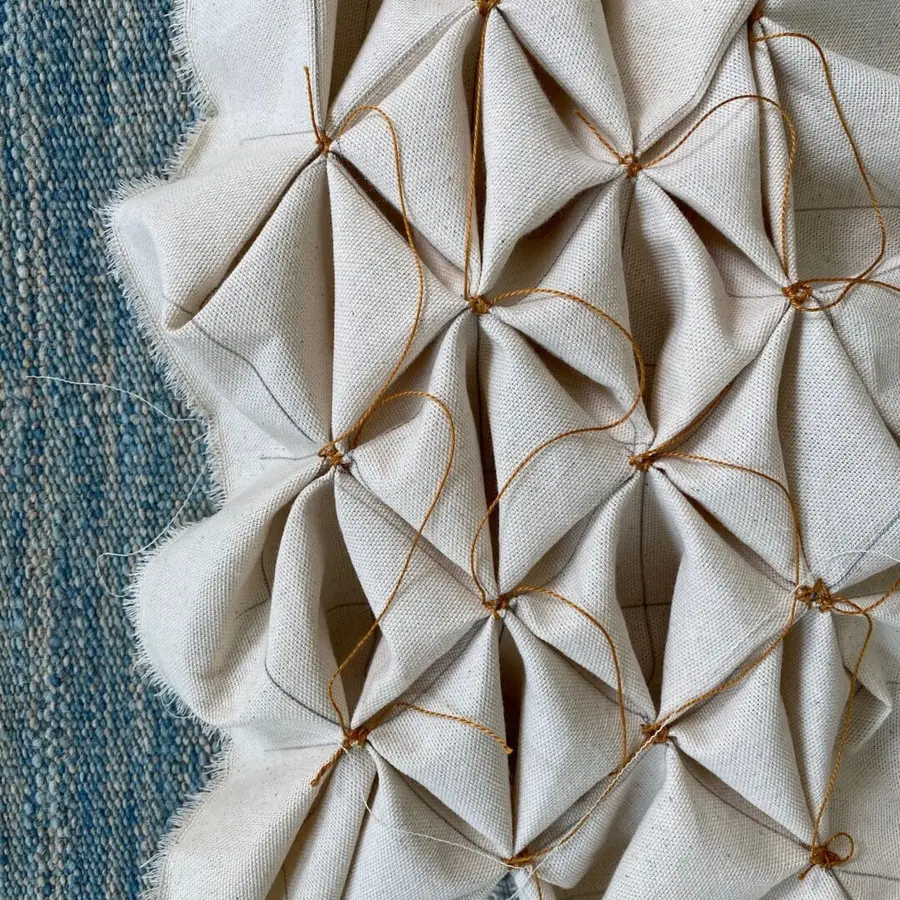
Table of Contents
Overview of Fabric Manipulation
Fabric manipulation techniques are methods used to intentionally change a textile’s surface, volume, texture, shape, or construction. Designers and makers may alter fabric through folding, stitching, gathering, joining, layering, embroidery, knotting, or decorative additions. The result can be subtle, such as a row of fine pin tucks, or highly dimensional, such as a quilted panel, knotted openwork, or heavily embellished garment surface.
In fashion and textile design, manipulation is both functional and decorative. A technique may control fullness at a waistline, create stretch at a bodice, strengthen a layered material, build a garment panel from smaller pieces, or add visual interest through relief and light reflection. Because every method changes how a fabric behaves, designers should consider weight, weave or knit structure, drape, stability, recovery, seam performance, care requirements, and intended end use before committing to a technique.
Common Fabric Manipulation Methods
The methods below represent common approaches to fabric manipulation in apparel, accessories, costume, interiors, and decorative textile work. Some primarily change fullness or fit, while others create raised texture, alter the visual surface, or construct a new textile component from separate materials.
Method selection should be based on the fabric and the product’s performance needs. Lightweight woven fabrics generally gather and shirr more readily than thick, stiff materials. Stable fabrics are often easier to pleat, tuck, embroider, or appliqué accurately, while fabrics with significant stretch may require stretch-compatible stitches, stabilizers, or revised pattern allowances. Sampling is essential because the same technique can produce very different results on cotton lawn, denim, jersey, silk satin, wool suiting, or coated synthetics.
1. Smocking
Smocking is decorative embroidery worked across controlled pleats or gathers. The embroidery stitches hold the gathered fabric in a planned arrangement, creating patterned texture and, in some applications, a degree of flexible fit. Traditional English smocking is usually hand worked over evenly prepared pleats, with stitches forming repeated geometric or pictorial effects.
The term is sometimes used casually for elastic-thread gathering, but traditional smocking and machine shirring are not the same construction. Smocking relies on embroidery stitches worked over pleated or gathered fabric; shirring commonly uses parallel rows of stitching with elastic thread. Both can reduce fabric width and create a textured surface, but their appearance, process, and stretch behavior differ.
Lightweight, stable woven fabrics that gather evenly are usually the easiest to smock. Cotton lawn, voile, fine cottons, and similar fabrics allow pleats to form clearly without excessive bulk. Dense, slippery, or heavy fabrics can be used, but they may require more careful preparation and testing to prevent uneven pleating or distorted embroidery.
2. Tucking
Tucks are folds of fabric secured by stitching. Unlike a dart, which removes a wedge of fabric to shape a garment, a tuck retains the folded material and creates a line of relief on the surface. Tucks can be functional, decorative, or both.
Pin tucks are narrow, closely stitched folds that create fine linear texture. Release tucks are stitched for part of their length and then allowed to open, producing controlled fullness below the stitched section. Decorative tucks may be arranged in parallel rows, radiating groups, angled formations, or more complex patterns. Fold direction, tuck depth, spacing, and stitch placement determine whether the result appears crisp, raised, soft, or sculptural.
Tucking is often used on shirt fronts, yokes, sleeves, dresses, and decorative panels. It can shape a relatively flat area while adding texture, but each tuck consumes fabric width. Pattern pieces should therefore include sufficient extra width, and the fabric should be pressed and marked accurately before stitching.
3. Shirring
Shirring is a series of stitched rows that pull fabric into repeated gathers. In garment sewing, it commonly uses elastic thread to create an elasticized section with stretch recovery. Parallel rows of shirring can produce a flexible, close-fitting area while retaining the soft visual effect of gathered fabric.
Typical applications include bodices, waistlines, cuffs, sleeve hems, necklines, and back panels. The gathered rows distribute fullness over a broad area rather than concentrating it into one seam. This makes shirring useful when a garment needs adaptable fit without relying on a separate elastic casing.
Lighter fabrics usually respond more effectively than thick or rigid materials because fine elastic thread has limited gathering power. Voile, double gauze, lawn, and rayon challis are commonly suitable choices. Heavier fabrics may not gather consistently and can place extra strain on the elastic thread. Test stitch length, thread tension, row spacing, and pressing method on a sample before sewing the final component.
4. Fabric Gathering
Gathering draws a longer fabric edge into a shorter length using one or more rows of stitching or dedicated gathering threads. The technique distributes extra fabric into a seam, creating controlled fullness. It is widely used in ruffles, gathered skirts, puffed sleeves, tiered garments, flounces, and decorative panels.
The fullness may be evenly distributed along the seam or concentrated in selected areas. Two or more rows of long machine stitches can help keep gathers aligned, while gathering stitches, gathering feet, or differential-feed equipment may improve consistency in production settings. The final seam must secure the gathers without creating weak points or uneven bulk.
Gathering differs from shirring because it does not necessarily create an elasticized area. A gathered skirt joined to a waistband, for example, contains added fullness but may have no stretch at the seam. Shirring, by contrast, generally uses repeated stitched rows and often elastic thread to make the gathered section flexible.
5. Appliqué
Appliqué is the application of cut fabric motifs onto a base fabric. The added shapes may create contrasting color, pattern, imagery, texture, or dimensional surface decoration. Appliqué can be used for small motifs, large graphic panels, lettering, badges, quilt blocks, and layered textile artworks.
Edges can be finished in several ways. Turned-edge appliqué encloses the raw edge before attachment. Raw-edge appliqué leaves the edge visible, which may be appropriate for felt, non-fraying materials, or intentionally frayed effects. Stitched appliqué may use straight stitching, satin stitching, zigzag, embroidery stitches, or free-motion stitching. Bonded appliqué uses an adhesive web or similar material, often followed by stitching for additional durability.
Stabilizers may be needed when the base fabric is lightweight, stretchy, loosely woven, or prone to puckering. The appropriate stabilizer depends on motif size, fabric weight, stitch density, intended drape, and laundering requirements. A large, dense motif on a lightweight knit will require different support from a small cotton patch on a woven twill.
6. Quilted Construction
Quilting joins layers of material through stitching. A conventional quilted construction includes a fabric face, a backing fabric, and often an intervening layer of batting or wadding. Stitching secures these layers while creating visible lines, raised areas, insulation, texture, and additional structural body.
Quilted construction may be decorative, functional, or both. In apparel, it is used for insulated jackets, vests, bags, linings, skirts, and fashion panels. Stitch patterns can be straight, channel-based, diamond-shaped, curved, geometric, or free-form. The chosen pattern affects not only appearance but also the distribution and stability of the internal layer.
Quilting differs from simple topstitching because it joins multiple layers into a composite material. Decorative topstitching may only reinforce or outline a seam on a single-layer fabric, whereas quilting creates a layered structure with altered thickness, warmth, stiffness, and drape.
7. Patchwork Assembly
Patchwork is the joining of separate fabric pieces to build a larger textile surface or garment component. Pieces may be geometric, irregular, tonal, printed, reclaimed, or intentionally contrasting. The technique can create a new design surface before the material is cut into garment parts, or it can be used directly within a garment panel.
Patchwork has a structural role because the joined pieces become the fabric surface itself. Unlike appliqué, which adds shapes on top of a base, patchwork relies on seams to connect individual sections. Seam layout can create strong visual direction through grids, stripes, blocks, radiating shapes, or irregular compositions.
Successful patchwork requires careful seam allowance management. Grain direction should be planned to avoid unexpected stretching or twisting, especially when combining bias-cut pieces with straight-grain pieces. Fabrics should also be compatible in weight, thickness, shrinkage, stretch, and care requirements. Joining a lightweight voile to a heavy denim, for example, may create uneven seam bulk and inconsistent wear unless the design is engineered for that contrast.
8. Macramé Knotting
Macramé is a textile construction and embellishment method based on decorative knotting rather than weaving or stitching. Cords, yarns, strips of fabric, or similar flexible materials are tied into repeated knot structures to create fringes, nets, cords, trims, and openwork surfaces.
The final result depends on cord type, knot structure, tension, spacing, and density. Tight knots and firm cord can create a strong, structured surface, while loosely spaced knots can produce open, draping, net-like effects. Common arrangements may include square knots, spiral effects, loops, fringes, and grid-based openwork.
In fashion and textile applications, macramé can appear in belts, bags, jewelry, trims, halter-style elements, decorative panels, and accessories. It is also used in home-textile and decorative objects. Designers should account for the material’s weight and stretch, particularly when macramé is used as a wearable panel that must retain its shape during use.
9. Rhinestone Embellishment
Rhinestones are reflective decorative components applied to textile surfaces to create sparkle, highlights, patterns, lettering, or stage-visible ornament. They may be attached by sewing, adhesive bonding, metal settings, or heat-fix systems, depending on the rhinestone type and fabric substrate.
Their main visual effect comes from light reflection. Placement density, stone size, color, and arrangement influence whether the result appears subtle, graphic, or highly theatrical. Rhinestones are commonly used in eveningwear, dancewear, costumes, performance apparel, accessories, and decorative fashion details.
Attachment method is critical to durability. The substrate must be compatible with the adhesive, setting, stitch, or heat process used. Garments exposed to frequent laundering, abrasion, flexing, or dry-cleaning need an attachment method appropriate to those conditions. A sample should be tested for adhesion, cracking, snagging, color transfer, and stone loss before production.
Key Takeaways
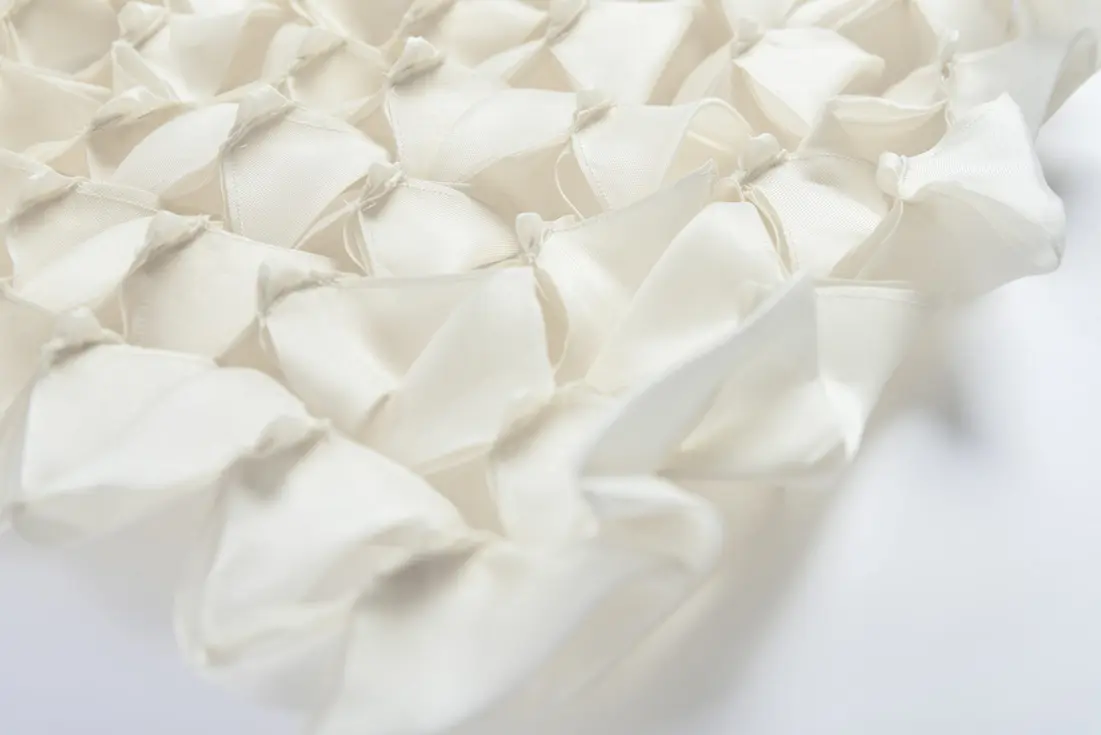
Fabric manipulation combines material behavior with construction technique. Smocking, tucking, shirring, and gathering primarily manage fullness, shape, and surface relief. Appliqué, rhinestones, and macramé add decorative or textural interest, while quilting and patchwork create more substantial changes to a textile’s structure.
No method is universally suitable for every fabric. Fabric weight, stability, drape, stretch, seam bulk, care requirements, and product use all affect the final result. Before applying a manipulation technique to a finished garment or textile product, make a sample using the intended fabric, thread, stabilizer, lining, and finishing method. Evaluate appearance, comfort, recovery, durability, and care performance before finalizing the design.
Source: Floriane Schmitt
Fabric Manipulation FAQs
Q1. What does fabric manipulation mean in fashion design?
In fashion design, fabric manipulation means deliberately changing a fabric’s surface, shape, texture, volume, or construction. The change may be created through folding, stitching, gathering, pleating, joining, layering, embroidery, knotting, or embellishment. These techniques can serve functional purposes, such as shaping and fit, as well as decorative purposes, such as texture and visual pattern.
Q2. How do smocking, shirring, and gathering differ?
Smocking generally refers to decorative embroidery worked over pleats or controlled gathers. Shirring usually consists of multiple parallel rows of stitching that gather fabric, often with elastic thread to create stretch. Gathering draws fabric fullness into a shorter length, typically for insertion into a seam, and does not necessarily create an elasticized section.
Q3. What fabrics work well for smocking and shirring?
Lightweight woven fabrics with a stable construction and good gathering behavior are generally easiest to control. Suitable examples include cotton lawn, voile, double gauze, and rayon challis. Slippery, heavy, very bulky, or unusually stretchy fabrics may still be usable, but they should be sampled first because pleating, stitch tension, elastic recovery, and surface appearance can vary significantly.
Q4. How are appliqué and patchwork different?
Appliqué attaches cut fabric shapes onto a base fabric, so it is primarily a surface-decoration method. Patchwork joins individual fabric pieces together to create a larger surface or garment component. Patchwork can therefore be integral to the textile structure, while appliqué usually remains an added layer on an existing base fabric.
Q5. Is fabric manipulation suitable for stretch fabrics?
Yes, but the technique must either preserve stretch and recovery or intentionally control them. Stretch fabrics may distort during gathering, tucking, embroidery, or appliqué, and manipulated areas can restrict extension if they are not engineered carefully. Test stitch type, thread, stabilizer, seam finish, and recovery on a sample. In some cases, a stretch stitch, elastic thread, knit-compatible stabilizer, or added seam support is needed to prevent puckering, popping stitches, or unwanted loss of stretch.
References
- https://textilelearner.net/fabric-manipulation-techniques. https://textilelearner.net/fabric-manipulation-techniques
- How to Smock Fabric with Elastic Thread {aka shirring}. https://www.itsalwaysautumn.com/smock-fabric-with-elastic-thread-shirring.html
- Shirring and Smocking: Essential Techniques for Sewing. https://sewingtrip.com/difference-between-shirring-and-smocking
- Smocking: The Art of Elegant Fabric Shaping. https://www.asg.org/smocking-the-art-of-elegant-fabric-shaping
- A Guide to Shirring. https://www.seamwork.com/sewing-tutorials/a-guide-to-elastic-shirring
- Ask Angie: Smocking vs. Shirring. https://youlookfab.com/welookfab/topic/ask-angie-smocking-vs-shirring
- How To Shirr Fabric | Shirring Tutorial. https://www.youtube.com/watch?v=FkZwWNshafY